




:max_bytes(150000):strip_icc()/kansas-10-20-23-none-c035f5793d3f40cbb1dd6ea0c887cbaa.png "Harvest in Kansas ‘hard to get excited about’ thanks to below average yields")
As harvest progresses across Kansas, some farmers are experiencing below average yields and pulling their cattle off pastures earlier than normal after a dry summer impacted their operations.
Glenn Brunkow, a fifth-generation farmer in Wamego, Kansas, grows corn, soybeans, milo, and hay, and says that yields are “really down” after drought conditions impacted his operation.
“Soybeans are less than half of a normal crop,” Brunkow says. He notes that his corn crop’s yields were predominantly below average. He says he’s finished up his dryland corn harvest, seeing yields of anywhere between 80 bushels per acre (bpa) and 120 bpa. An average year yields 120 to 130 bpa, Brunkow says.
While Brunkow hasn’t begun harvesting his soybeans yet, he anticipates that yields won’t be very good. He says this is because his farm didn’t receive any significant rainfall from late July to early October, “right when it was most critical for the soybeans.”
In addition to dry weather, a high heat index also caused damage to his soybeans while they were flowering, Brunkow says, resulting in the anticipated low yields.
When it comes to the drought, Brunkow says he checks the drought monitor every week, and every week drought conditions get a little worse in his area.
The latest drought monitor map shows that 2% of Kansas is in D4 exceptional drought. Nearly 19% is in D3 extreme drought, 30% is in D2 severe drought, 18% is in D1 moderate drought, and almost 16% is abnormally dry. The remaining 17% of the state’s acres are free of drought stress.
Brunkow says he’s actually been putting off harvesting his soybean crop because they “still had green in them.
“Honestly, it was hard to get excited about the harvest when it was below average,” Brunkow says.
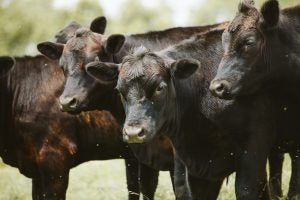
Instead, Brunkow has been taking care of his cattle. “It made more financial sense to get the cows weaned and off hay,” he notes. After all, Brunkow says that hay prices are high this year, and his own hay crop didn’t yield much.
In a typical year, Brunkow says his cattle would still be out on pasture until Nov. 1. Unfortunately, the dry weather has left his pastures looking poor, so he says he only has one group of cattle still on pasture while the remainder have been pulled off grass.
USDA’s Crop Progress report for Kansas for the week ending Oct. 15 shows that pasture and range conditions rated 25% very poor, 28% poor, 33% fair, 13% good, and 1% excellent.
Luckily, Brunkow says he hasn’t had to haul any water to his cattle this year thanks to heavy rains this spring that kept his water sources filled throughout the hot summer months.
Drought Monitor
To help keep the cattle fed this winter, Brunkow says he planted some rye to serve as forage for his herd to graze. In fact, he says that in the last three weeks or so, his operation has received some decent precipitation to help his rye crop out.
The recent rains have also helped improve the subsoil moisture on his operation, Brunkow says. However, he says his farm is going to need steady rain to really help the subsoil moisture supplies for next year’s crops.
The recent Crop Progress report for Kansas shows that subsoil moisture supplies rated 37% very short, 39% short, 24% adequate, and 0% surplus. Topsoil moisture supplies rated 32% very short, 38% short, 29% adequate, and 1% surplus.
Regardless of how yields have been this year, Brunkow is keeping the faith. “Things will be better next year,” he says.
:max_bytes(150000):strip_icc()/Jared-Strong-dry-soil2-04232ccb7f6b4e9cb0fcc2c0382d5358.jpeg "February was among the warmest and driest on record in Iowa")
:max_bytes(150000):strip_icc()/drought20corn2040042143893_3854aa3222_c-1-a90bb0b3f3f44de583ba7dccc190a0ae.jpg "Heat threatens to reduce soil moisture in central Brazil")
:max_bytes(150000):strip_icc()/current_ia_none2-61ed5078a019457f87662f5956802daa.png "Iowa’s drought improves slightly in past month")
:max_bytes(150000):strip_icc()/AEREAS20LEM20-20HH200048-2000-ba729658a25f496db64088e0d316a24c.jpg "Turning wetter in central Brazil")
:max_bytes(150000):strip_icc()/current_ms_none1-1de6ad66243f47e8a718be456f61abe8.png "El Niño has ‘done its job’ in Mississippi, says state climatologist")
:max_bytes(150000):strip_icc()/26334036103_2c3949ae6f_o-58af4eed82b1485eb6af63a33a2d6b92.jpg "Rain makes return to parched farmlands in Argentina")