




As climate change worsens global drought conditions, hindering crop production, the search for ways to capture and store atmospheric carbon causing the phenomenon has intensified. Penn State researchers have developed a new high-tech tool that could spur changes in how crops withstand drought, acquire nitrogen, and store carbon deeper in soil.
In findings recently published in Crop Science, they describe a process in which the depth of plant roots can be accurately estimated by scanning leaves with X-ray fluorescence spectroscopy, a process that detects chemical elements in the foliage. The method recognizes that roots take up elements they encounter, depending on the depth they reach, and a correlation exists between chemical elements in the leaves and root depth.
The new technology is the subject of a provisional patent application by Penn State, because it promises to speed up the plant-breeding process, according to research team leader Jonathan Lynch, distinguished professor of plant science in the College of Agricultural Sciences. The ability to measure the depth of plant roots without excavating them is a game-changing technology, he said.
“We’ve known about the benefits of deeper rooting crops for a long time — they are more drought tolerant and have an enhanced ability to take up nitrogen, which tends to move deep with water — but the problem has been how to measure root depth in the field,” he said. “To breed deeper-rooted crops, you need to look at thousands of plants. Digging them up is expensive and time consuming because some of those roots are down 2 meters or more. Everybody wants deep-rooted crops — but until now, we didn’t know how to get them.”
An added benefit to deeper-rooting crops, Lynch noted, is that they store carbon in the soil more effectively. And soil is the right place to put carbon, he pointed out, because carbon in the atmosphere is a bad thing — it causes global warming. Carbon in the soil is a good thing — it boosts fertility.
“Having deeper roots means that carbon the plants get from photosynthesis is stored down deeper in the soil when they build roots. And the deeper carbon is put in the soil, the longer it stays in the soil,” he said. “The U.S. Department of Energy estimates that just having deep-rooted crops in America alone could offset years of our total carbon emissions. That’s huge —think about all the acres growing crops in America. If those roots grow just a little bit deeper, then we’re storing massive amounts of carbon deeper in the soil.”
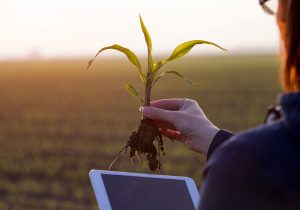
Developing the new method — which the researchers called LEADER (Leaf Element Accumulation from DEep Root) — took six years and involved the collection and analysis of more than 2,000 soil core samples at four research sites across the country, noted Molly Hanlon, a former postdoctoral scholar in Lynch’s research group, who spearheaded the study.
It involved growing a set of 30 genetically distinct lines of corn at Penn State’s Russell E. Larson Agricultural Research Center, the University of Colorado’s Agricultural Research and Education Center, the University of Wisconsin Arlington Agricultural Research Station, and the University of Wisconsin Hancock Agricultural Research Station. The researchers found that they could correctly classify the plots with the longest deep root lengths — deeper than 30 or 40 centimeters — using the LEADER method with high accuracy.
A major tenet of soil science is that biological, physical, and chemical properties vary with soil depth, explained Hanlon, now a senior research scientist with Donald Danforth Plant Science Center in St. Louis.
“And plant roots grow through these different soil layers,” she said. “The elements are then transported to the shoot where we can quickly and easily assay the elemental content of leaf tissue using X-ray fluorescence. In this way, the leaves can serve as indicators or sensors of where the roots are in the soil.”
In the study, the researchers were able to accurately estimate root depth by analyzing the foliar accumulation of elements naturally occurring in diverse soils. As an alternative method for assessing root depth, in both field and greenhouse experiments, they injected strontium into the soil at a set depth as a tracer for LEADER analysis. Later, they harvested plants growing nearby and determined that strontium detected in the leaves strongly correlated to the depth of their roots.
Although the LEADER method was accomplished with corn, it offers a wider application, Lynch suggested.
“It shows promise as a tool for measuring root depth in different plant species and soils,” he said. “It made sense to do this research with corn — it’s one of the world’s most important crops, grown extensively as a staple food for humans, livestock feed, as a biofuel and as a starting material in industry. Deeper-rooted corn crops able take up more water and nitrogen under limiting conditions, with increased long-term soil carbon storage would be a major development. But this LEADER method can be used with all plants.”