





Spicy food lovers know that milk can ease the oral burn, but the reason behind why that happens hasn’t always been clear? Some people believe that fat is the soother, with whole cow’s milk reducing the bite more than low-fat cow’s milk or plant-based alternatives. However, a new study conducted by Penn State food scientists suggests that protein plays a role in cooling the heat sensation, too.
Full-fat milk is not more effective than fat-free milk in cooling the burning sensation, according to the results of controlled laboratory studies in Penn State’s Sensory Evaluation Center. The findings were part of a paper titled, Proteins in dairy and plant milks contribute to the reduction of oral burn from capsaicin, and were published in Food Quality and Preference. According to corresponding author John Hayes, professor of food science and director of the center, the work suggests other components may contribute to milk’s effectiveness.
“Common folklore and data from the late ’80s each suggest whole cow’s milk is best when you overdo the hot sauce,” he said. “These data reconfirm that belief, while also showing high protein, ultra-filtered full-fat milk outperforms conventional full-fat milk. We also show that soy milk cuts the burn, and soy milk with more protein works better.”
The ultrafiltration technique involves filtering out and retaining various components, and then recombining the fluid in a way that results in higher contents of nutrients such as protein and calcium. Milks made this way offer consumers dairy products with increased health benefits, according to the researchers.
Collectively, the study results suggest the classic interpretation — that fat is what cuts the burn caused by the chili extract capsaicin — is an oversimplification, Hayes explained, because protein content matters too.
“This work has implications not only for sensory testing labs and chili heads, but also for food manufacturers,” Hayes said. “Specifically, it implies that protein-capsaicin interactions should be considered when formulating products.”
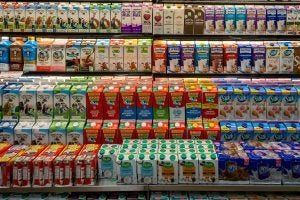
Lead researcher Justin Gaiser, a doctoral candidate in food science, conducted two experiments with moderate capsaicin consumers to investigate the effectiveness of dairy and plant-based alternatives varying in fat and protein content.
In the first experiment, participants repeatedly were exposed to a capsaicin solution before rinsing with, respectively, conventional full-fat cow’s milk, ultra-filtered full-fat milk, almond milk, soy milk and pea protein-enriched flax milk. In experiment two, after each capsaicin encounter, they rinsed with, respectively, fat-free, conventional full-fat and ultra-filtered full-fat milk, and three soy milks of varying protein content.
Participants rated the burning sensation they experienced once every 10 seconds for two minutes in the first experiment, and continuously for two minutes in the second experiment.
Both experiments showed significant reductions in the burning sensation over time. In experiment one, participants rated conventional and ultra-filtered full-fat milk as significantly better than water in reducing the burning sensation from capsaicin. Both soy milk and dairy milk significantly out-performed water in experiment two.
Both experiments pointed to ultra-filtered, high-protein, full-fat milk as the most efficient in reducing the burning sensation from capsaicin. They also provide some evidence that higher concentrations of protein helped mitigate capsaicin burn, Gaiser reported, although more research is needed to quantify the relative contributions of fat and protein.
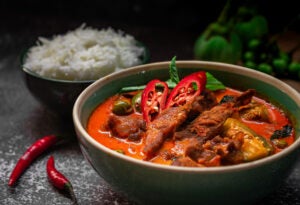
While the findings may be useful for consumers, Gaiser said they may also have broader industry applications, especially for taste testers.
“The general public is interested in novel ideas like how the burn of spicy food can be reduced, especially if a person doesn’t like spicy food,” he said. “But the main application that we see of this research is within the food industry, because chemesthetic sensations — and spiciness especially — take a long time to completely subside. So, if we can find the most effective way to reduce the burning sensation in somebody’s mouth, it allows for people within the industry to test more effectively, tasting more samples in a shorter amount of time, and still get accurate results.”
