




Roundworm parasites infect humans, livestock, and crop plants. Insights into why certain worms can evade host immune protections could help explain why pesticides and antibiotics for infections aren’t always as effective anymore.
Bacterial, fungal, and parasite resistance to drugs and pesticides is making it harder, and sometimes impossible, to treat common infections like pneumonia and tuberculosis in humans and pest infestations in crops. International health officials warn that without urgent action, we are heading toward a future in which minor injuries and infections can kill. Crop and livestock production will also face increasing hurdles.
To study how parasites evolve to break the defenses of their hosts, the National Institutes of Health has granted UC Riverside nematologist Simon “Niels” Groen a $1.9 million Outstanding Investigator Award.
“When roundworms infect either humans, animals or plants, they start injecting proteins from their saliva into host cells to subvert the immune response,” Groen said. “These processes are pretty similar across hosts, which is why we can study coevolutionary arms races between plants and parasitic worms and make inferences about the evolution of worm infections in people.”
Over the next five years, Groen will use the funds to conduct a study in two parts. The first part of the project will examine hundreds of tomato and rice plants, both those grown on farms and those growing in the wild. These are not plants artificially bred for immunity, but Groen expects many will have developed defenses against infectious roundworms, also called nematodes.
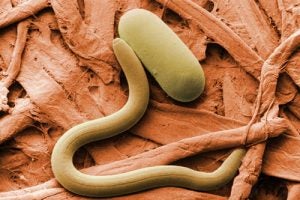
“These plants are a natural laboratory in which we can link their genes and chemical characteristics of their roots to their resistance to worm infections,” Groen said.
“We will learn the molecular mechanisms by which plants defend themselves. This includes the production of defensive chemicals, some of which could be harnessed as novel drugs or antibiotics in humans and livestock,” Groen said. “We can then share this information with biomedical researchers and crop breeders.”
This aspect of the project will also help increase food security, particularly in parts of Africa and Asia where nematodes pose a problem for farmers. Much research has been done on above-ground insect pests, but less work has been done below ground, where nematode infections attack the most economically important crops.
“Nematodes make up the most devastating threat to soybeans. For rice and tomatoes, nematodes may cause up to 20 percent loss of yield. That’s a lot of people who don’t get to eat,” Groen said.
For the second part of the project, the research team will look at the nematode side of the equation. “How do they evolve to break the plants’ resistance?” Groen asked.
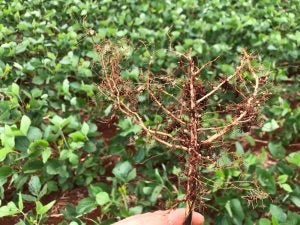
There is a gene in tomatoes, Mi-1, that surveys the inside of plant cells for incoming attacks. In a way that is not yet fully understood, this gene perceives something about impending nematode infections that triggers an effective immune response.
Mi-1 was discovered in wild tomatoes in the 1940s and has been bred into California processing tomatoes ever since to keep nematodes at bay. Groen explained that this breeding scheme put root-knot nematodes under enormous natural selection pressure to overcome the resistance conferred by the gene.
However, in increasing numbers, farmers are now finding nematodes in their supposedly resistant tomato crops. “We don’t understand how they broke the resistance. Is there one way or multiple ways they were able to do this? We will try to identify how many ways there are to skin a cat, from a nematode’s perspective,” Groen said.
Thanks to UC Extension specialists, Groen’s team will be able to compare the genes of worms collected before resistance breaking became more common, as well as ones that have been able to squirm past the plant’s immunity barriers.
One hypothesis is that when the nematode enters the plant, it injects proteins with its saliva that have different targets in the host cell. When Mi-1, floating around in the cell, comes across one of these nematode proteins, it triggers an immune response that kills the worm. However, if the worm no longer injects that protein, then Mi-1 doesn’t know the invader has arrived.
There are receptor proteins like Mi-1 that have evolved similarly in humans that survey cells for incoming attacks, as well as additional molecular processes that resemble one another in humans and plants. However, given ethical and logistical considerations when studying infections in humans, it makes sense to begin this research with plants and nematodes.
“The worms are only one model system to look at resistance breaking. But they may yet help us find new solutions to pesticide and antibiotic resistance,” Groen said.