

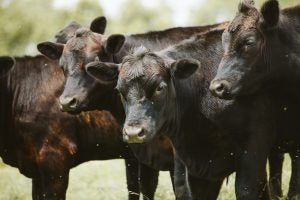



Maybe you can’t tell the difference between 15 and 32 degrees Fahrenheit after spending a few minutes outside, but your cattle can.
“Slight changes in temperature can have a considerable impact on energy and cow nutritional requirements,” said Elizabeth Belew, Ph.D., cattle nutritionist with Purina Animal Nutrition.
Cold stress occurs when cattle require more energy to sustain basic bodily functions at a specific temperature, called the lower critical temperature. The LCT helps us understand when cows start experiencing cold stress.
“As temperatures decrease, cow nutritional requirements increase. Add in precipitation or wind, and requirements increase even more,” said Belew.
If cows are shorted on nutrition during cold stress, it can have a domino effect on performance.
“Nutritional deficiency resulting from cold stress can lead to cows producing lighter and weaker calves,” said Belew. “Low-quality colostrum and later return to estrus in the breeding season can also result, compromising conception rates and weaning weights.”
Strategies for managing and feeding cattle in the winter can help alleviate cold stress and support cow nutritional requirements.

How can you mitigate cold stress?
Cold stress mitigation should start with keeping cattle warm. Offering protection from the elements like bedding, windbreaks, snow breaks and a place to get out of the mud can all help keep cattle warm and dry. Protecting cattle from wind, rain and snow isn’t always enough, however.
“Snow often reminds us to think about cow nutritional requirements and supplementation options. But what if the snow never falls? Temperature is the underlying factor in cold stress,” said Belew.
When feeding cattle in winter, provide them with nutrition to meet their needs during cold stress. Plan out feeding strategies early, before cow body condition scores start to slip, to help your cows weather cold temperatures.
Know your forages
Feeding cattle stored forage can be challenging. Testing forages gives you a better understanding of what you’re feeding cattle in winter when temperatures drop.
Testing total digestible nutrients (TDN) will provide an estimate of the total amount of nutrients that could be digested by the animal. The greater the TDN value, the more energy cattle get from forages.
”Forage intake is another consideration,” said Belew. “Cows will likely spend less time grazing as temperatures decline. Less grazing time results in reduced forage intake which makes it challenging to meet cow energy requirements. Feeding cattle in winter with low-quality hay might not be enough to offset reduced forage intake.”
Once you know forage nutritional value and assess intake levels, monitor cow body condition score (BCS) and temperature to identify cow energy requirements.

Evaluate cow nutritional requirements
As a rule of thumb, a cow’s energy requirement, or TDN, increases by 1% for every degree below the LCT.
“Cow body condition scores impact nutritional requirements,” said Belew. “A cow in a BCS 5 needs 30 percent more energy to maintain body condition than a cow in a BCS 6 at 32 degrees F. The same principle holds true as BCS decreases below 5.”
A third-trimester 1,300-pound cow requires 13 pounds of TDN at 32 degrees F. However, at 0 degrees Fahrenheit, the same cow needs an additional 4 pounds, or roughly 17 pounds of TDN. For comparison, the temperature drop means the same cow now requires 8 more pounds of 50 percent TDN hay.
“When feeding cattle in winter, consider a high-quality supplement to help fill a cow’s energy gap while helping cows get the most out of existing forages,” said Belew. “The ideal supplement should provide additional energy, balance forage nutrient deficiencies, and support performance.”
This piece was submitted by Purina.
»Related: Protecting farms during the winter months
