




Agriculture TrendsAgriculture Trends
  • Home
  • News
  • Business
  • Insights
  • Crops
  • Livestock
  • Machinery
  • Technology
  • Farm Management
  • Weather
  • More
    • Web Stories
    • Press Release
    • Trending

Subscribe to Updates

Get the latest agriculture news and updates directly to your inbox.

What's On
AFBF: Cash rents up 3.2% as commodity prices slide

AFBF: Cash rents up 3.2% as commodity prices slide

August 8, 2024
How farms have fared as Debby delivers hard blow to Southeast U.S.

How farms have fared as Debby delivers hard blow to Southeast U.S.

August 8, 2024
New USDA rules aim to strengthen farm financial stability

New USDA rules aim to strengthen farm financial stability

August 8, 2024
Facebook X (Twitter) Instagram
Agriculture TrendsAgriculture Trends
  • Privacy Policy
  • Terms of use
  • Advertise
  • Contact Us
Facebook X (Twitter) Instagram
SUBSCRIBE
  • Home
  • News
  • Business
  • Insights
  • Crops
  • Livestock
  • Machinery
  • Technology
  • Farm Management
  • Weather
  • More
    • Web Stories
    • Press Release
    • Trending
Agriculture TrendsAgriculture Trends
Home » CDC reports Asian longhorned ticks spread to 19 U.S. states

CDC reports Asian longhorned ticks spread to 19 U.S. states

May 8, 20243 Mins Read News
CDC reports Asian longhorned ticks spread to 19 U.S. states
Share
Facebook Twitter LinkedIn Pinterest WhatsApp Email
CDC reports Asian longhorned ticks spread to 19 U.S. states

Asian longhorned ticks — an invasive species that the U.S. Department of Agriculture says pose a serious threat to livestock — are now confirmed in 19 U.S. states. 

Compared with well-known native ticks (such as the black-legged tick, lone star tick, and American dog tick), the Asian longhorned tick appears to be less attracted to human skin. However, first reported in the U.S. in 2017, the ticks have been found on pets, livestock, wildlife, and even some people. The female ticks are especially impressive as they reproduce without mating, and thousands may be found at a time on grass, shrubs, or animals.

Asian longhorned ticks’ secret colonization weapon is the ability to reproduce asexually, with each female laying up to 2,000 eggs at a time — and all 2,000 of those female offspring able to do the same.
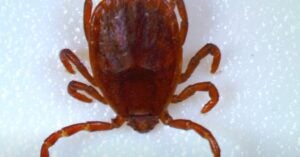
Image by Penn State Extension

Because of their ability to hide in vegetation, Asian longhorned ticks also can escape pesticides that kill only when coming into direct contact with a pest.

The Centers for Disease Control and Prevention reported in April that the ticks have now been confirmed in Arkansas, Connecticut, Delaware, Georgia, Kentucky, Maryland, Missouri, New Jersey, New York, North Carolina, Ohio, Pennsylvania, Rhode Island, South Carolina, Tennessee, Virginia, and West Virginia. The two newest states added are Indiana and Massachusetts.

Because of their ability to infest a host in such large numbers, impacted growth, performance, milk production, and even death can occur in host animals. In Ohio, one farmer noted that a healthy, male bull, of about 5 years old, was taken down by exsanguination by ticks. 

While a recent experimental study found that ticks are not likely to contribute to the spread of Lyme disease bacteria in the United States, other bacteria and protozoans are a concern. 

Another laboratory study found that this tick can carry and spread the bacteria that causes Rocky Mountain spotted fever (Rickettsia rickettsii). The germs that cause Rocky Mountain spotted fever have not yet been found in these ticks in nature.

Asian longhorn ticks also carry a protozoal organism called Theileria orientalis, which causes cattle disease. Theileria affects red blood cells and may destroy them, causing anemia in affected animals.

According to the USDA, it only takes one tick to create a population in a new location. Once established, control can be difficult. Because of their ability to hide in vegetation, Asian longhorned ticks also can escape pesticides that kill only when coming into direct contact with a pest.

CDC-recommended personal protective measures such as the use of EPA-approved insect repellents and 0.5 percent permethrin-treated clothing are effective against Asian longhorned ticks.


Share. Facebook Twitter Pinterest LinkedIn Tumblr Email

Related Posts

AFBF: Cash rents up 3.2% as commodity prices slide

AFBF: Cash rents up 3.2% as commodity prices slide

August 8, 2024 News
How farms have fared as Debby delivers hard blow to Southeast U.S.

How farms have fared as Debby delivers hard blow to Southeast U.S.

August 8, 2024 News
New USDA rules aim to strengthen farm financial stability

New USDA rules aim to strengthen farm financial stability

August 8, 2024 News

2024 election heats up over Harris’ red meat statements

August 7, 2024 News

College Aggies Online announces mentor and rancher Natalie Kovarik

August 7, 2024 News

N.C. man pleads guilty in $1 million livestock theft scheme

August 7, 2024 News

Leave A Reply Cancel Reply

Don't Miss
How farms have fared as Debby delivers hard blow to Southeast U.S. News

How farms have fared as Debby delivers hard blow to Southeast U.S.

By staffAugust 8, 20240

Some farms are under water and the U.S. Department of Agriculture has pledged resources to…

New USDA rules aim to strengthen farm financial stability

New USDA rules aim to strengthen farm financial stability

August 8, 2024
Viewpoint: The uglier side of solar farming is impacting agriculture

Viewpoint: The uglier side of solar farming is impacting agriculture

August 8, 2024

2024 election heats up over Harris’ red meat statements

August 7, 2024

Subscribe to Updates

Get the latest agriculture news and updates directly to your inbox.

Our Picks

College Aggies Online announces mentor and rancher Natalie Kovarik

August 7, 2024

N.C. man pleads guilty in $1 million livestock theft scheme

August 7, 2024
Chasing 8 Stunning Waterfalls In Munnar

Chasing 8 Stunning Waterfalls In Munnar

August 7, 2024
EPA takes historic action to halt specialty-crop herbicide

EPA takes historic action to halt specialty-crop herbicide

August 7, 2024
Agriculture Trends
Facebook X (Twitter) Instagram Pinterest
  • Privacy Policy
  • Terms of use
  • Advertise
  • Contact Us
© 2026 All rights reserved. Agriculture Trends.

Type above and press Enter to search. Press Esc to cancel.